Showing posts with label France. Show all posts

Friday, May 6, 2016

Film Review: Monsieur Chocolat

[post 420]

Foottit & Chocolat were a legendary clown duo in turn-of-the-century, belle époque Paris, famed for their trailblazing partnership: the first white/black clown duo and first popular clown pairing of white face and auguste. Chocolat, born Rafael Padilla to slaves in Haiti, was to become France's first black celebrity, long before Josephine Baker.

The story of the rise and fall of Chocolat's career and its relation to racial politics has intrigued many writers, and it has recently gained more attention with a French play and a new biography (both by Gérard Noiriel), an exhibition, and now the release in France of a major motion picture, Monsieur Chocolat, starring the celebrated French actor Omar Sy and the exceptional physical comedian and clown, James Thiérrée.

Omar Sy & James Thiérrée in Monsieur Chocolat
The film has yet to find an American distributor, though I'm guessing it will. Meanwhile, I was lucky to catch it my last day in Barcelona. My cut-to-the-chase verdict:

Clowning / Physical Comedy:  A
Acting:  A
Cinematography:  A
Writing / Historical Accuracy:  D

Here's the official trailer.


The good news is that the depiction of circus life and the fragments of some very physical clown acts are well done, thanks no doubt to Thiérrée not only playing Foottit, but also choreographing the action. Thiérrée (grandson of Charlie Chaplin) has the physicality to pull off the manic acrobatic clowning of Foottit, who was very much in the robust tradition of 19th-century British knockabout comedy. And Sy, like Chocolat not coming out of the clown School of Hard Knocks, still very much holds his own in and out of the ring. You can actually imagine the audience finding them funny!

Only a few short film clips survive of Foottit & Chocolat. Filmed away from the circus ring, these first two clips, shot in 1896 by French film pioneers the Lumière brothers, show fragments of a William Tell entrée and a chair routine.


This longer, colorized clip, likewise shot without an audience, provides more clues as to the range of their work and Foottit's agility.


In Fellini's film, I Clowns (1970), he had two contemporary clowns depict what Foottit & Chocolat's chair routine might have looked like. The results seem tamer and much jollier than the original work. (The old man in the audience is the clown James Guyon —Paris' first famous auguste— who escaped from his hospital death bed to catch one last performance at the Nouveau Cirque, but the excitement led to a heart attack that killed him —or so the story goes.)


Now back to the movie and that storyline, and why did I only give it a "D"?

First of all, some credit to the filmmakers for tackling an important subject. It's a tricky one, because the act very likely contained racist elements, and yet Chocolat often got to be on top and slap and throw Foottit around the ring. Chocolat played the auguste, aka "he who gets slapped," so being the fall guy wasn't by definition racist, though many spectators might have especially enjoyed that aspect of it precisely because he was black, while others may have savored his moments of revenge.
Chocolat Dancing in
the Irish-American Bar

Toulouse-Lautrec (1896)

We would have to have been there to truly understand the dynamics, but my sense is that the film oversimplifies matters considerably. In the movie, Foottit discovers Chocolat earning a  meager living in a poor provincial circus, playing an African "savage" whose job it is to frighten the locals. Foottit creates an act for the two of them, audiences love it, and a producer brings them to Paris. Their big break!! Their first taste of the splendors of the City of Light!! They become stars but flame out after what seems to be just a couple of years when Chocolat has had enough of being the lesser-paid, somewhat abused underling, slaps Foottit hard in the ring, and storms out, turning his back on him forever. Gambling and drinking send Chocolat on a downward spiral from which he never recovers.

Very dramatic and all, but...... not much of it is true. Chocolat was actually discovered by another
well-known clown, Tony Grice, around 1884, started performing in Paris in 1886, and soon gained a reputation as a very funny auguste, often working independently, as augustes did at the time. He was featured in several water pantomimes at the Nouveau Cirque, including starring in La Noce de Chocolat (The Wedding of Chocolat) in 1887 —with a white bride, no less.

When Foottit and Chocolat teamed up in 1890,  they were both already famous as comedians, in the ring and on the variety stage. And their partnership endured until 1909, which if you're counting is 19 years together —in clown years a lifetime. In the final stretch, they were both branching out, with solo appearances in  pantomime and music hall, notably at the Folies-Bergère. Nothing all that dramatic.

A biopic is bound to compress history and simplify matters in order to expound a theme, but the distortions in this narrative are large enough to drive a circus wagon through. A few other examples:
• Chocolat died of a heart attack, not tuberculosis, and Foottit did not miraculously materialize at his bedside, just in time for the duo to reconcile, Chocolat taking his last breath as we fade to black.
• They were not the first whiteface-auguste team, just the first wildly popular one.
• Foottit had two sons who eventually joined him in the ring; in the movie he is a loner, no family, and there is a strong implication that he is gay.
• Foottit was British and part of his comic persona was speaking French with a horrible accent; Thiérrée is Swiss and in the movie speaks normal French.
• In the film, Chocolat struggles with alcoholism. In life, they both did.

You get the point... Oh well, there's still a lot to like, so go see the movie, and kudos to Sy and Thiérrée. Worth the price of admission!


UPDATE: Moshe Cohen was so kind as to forward me this article in French which goes further in detailing the larger historical distortions that make the movie such a mess.

Click here for an excellent Circopedia entry on Foottit & Chocolat.
Click here for a post of mine on Footit & Chocolat from 4 years ago.
Click here for a post of mine from 5 1/2 years ago on James Thiérrée.
Click here for an article that explains why not everyone loves Fellini's I Clowns.
Click here for a good interview (in French) with Sy and Thiérrée.

Friday, March 20, 2015

Sexagenarian Physical Comedy


[post 403]
 
I was going to call this post "Old-Fart Physical Comedy" but I thought I'd pull in more readers this way. Sexagenarian must have something to do with sex, right? Maybe there'll even be pictures! No, but while you're here...

Mike ("Buster the Clown") Bednarek writes: : One week short of turning 60, nursing an aching back, and fully realizing and appreciating the growing limitations  on my physical body when it asks to do some of the same bits from 10, 20, 30 years ago, I've got a question for you. What do older physical comedians/clowns do when their bodies tell their heads (usually after the fact, when it's too late): "Are you f---ing nuts?"

Well, I'm 66 and still throwing my weary bones around, so I think this is a very good question and that a serious answer would make for a useful blog post. So do any aging veterans of the physical comedy wars want to share their old-fart experiences and longevity recommendations with our readers? If so, just e-mail me a few thoughts and I'll take it from there.

Meanwhile, we might as well laugh at ourselves, so here are two comic takes on the sexagenarian physical comedian. The first is a 1959 performance by the Talo Boys on the French tv show La Piste aux Étoiles, live from the Moulin de la Galette. (Thanks to Max Weldy for the original video!) The opening is pretty much straight acrobatics, though we see that some troupe members are  not exactly spring chickens. At the 1:45 mark they get into some comedy schtick, but the old-man physical comedy starts at 4:40 when they re-enter as moustachioed "acrobates de la Belle Époque."


And 54 years later here's a piece in a similar (varicose) vein by "Fumagali and their Fumaboys," as they appeared on another French tv show, Le Plus Grand Cabaret du Monde (2013), and which I saw that same year at the Cirque d'Hiver in Paris.


Update (3-21-15)  
Raffaele De Ritis writes: Fuma Boys act was conceived and created in the late 90s by Bernhard Paul, collector and founder of Circus Roncalli, under direct and deliberate inspiration of Talo Boys.

And just for inspiration, here's how Buster Keaton entered his sixties.


And finally, one more cartoon...


Update (3-21-15):
Click here  for a similar piece by Fratelli Bologna from about 1989. Thanks to Drew Letchworth for the link, who writes "We weren't Sexagenarians when we did this piece, but we are now. We developed The Old Act in part because we found that we were getting too old to do the young act."


Wednesday, March 11, 2015

Georges Holmes

[post 401]

I have yet to find any biographical information on the multi-talented Georges Holmes, but this performance is from the French tv show La Piste aux Etoiles, from the same 1959 broadcast as Les Marcellys in my previous post. Also, his first name is spelled the French way, and the few words he speaks are in French, so let's assume he's French. He's a tap dancer, acrobat, magician, and object manipulator. He's quite the human smokestack, and also does one of my favorite "stupid human tricks," the back roll with the cup of water. A variety artist full of variety!


Thursday, April 17, 2014

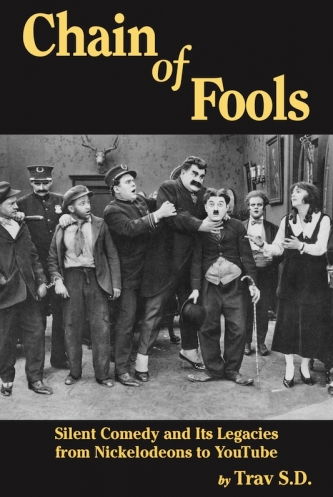
Book Report: Chain of Fools

[post 376]

Chain of Fools
Silent Comedy and Its Legacies
from Nickelodeons to YouTube
by Trav S.D.

Trav S.D. —oddly enough named after his gritty home town in the middle of South Dakota's Badlands — is a so-good-he's-bad vaudevillian: a performer, producer, historian, popularizer, and blogger whose popular blog Travalanche is a must for the variety arts fan.

I remember when I first came across his book, No Applause, Just Throw Money: The Book that Made Vaudeville Famous. I couldn't help but think "do we really need another history of vaudeville?" Then I read the book and discovered that the author was a really good writer, a prodigious researcher, and had a fresh slant on his subject matter. When I heard he was publishing a book on silent film comedy, I couldn't help but think "do we really need another history of silent film comedy?" Then I read the book and... yep, you guessed it.

Trav S.D.
A lot of people read book reviews but don't read books, but if you're just the opposite and are already zoning out then let me cut to the chase and simply say that if you're reading this blog (on purpose) then you'll probably find Chain of Fools highly entertaining and informative.


Here's just a few of the things you will like about it:

• I highlighted something on almost every page. It's just chock full of info that was new to me and very interesting.
• He writes very lively and conversational prose, the kind I like to write but don't always succeed at. Nothing pedantic here. He searches for and almost always finds an interesting way to say what he has to say.
• He's very good at context. You really get the feeling what the work and artistic environment must have been for those creating this new medium.
• He makes a convincing case for silent film comedy as a unique art form and not just as a collection of funny performers.
• He doesn't pretend that every silent film comedy was wonderful.
• He's strong on the relationship between story and character.
• He appreciates what Paris and French culture meant to the arts and the growth of cinema.
• He makes Mack Sennett very interesting.
• He has fresh insights on many of the comedians; Harry Langdon and Lupino Lane, to name just two.


Any weaknesses, quibbles, reservations?

• It's sparsely illustrated, and the discussion of individual films will have much more value if you have them on DVD or can find them online. Since he can't assume you do, a lot of space has to be devoted to plot summaries. He handles them well, but exposition is exposition.
• His pre-cinema comedy history is sketchy and is missing some pretty clear links between the two eras.
• Physical techniques aren't discussed in any detail.
• Max Linder's feature films are given short shrift, and some of the comedians of the 40s and 50s (e.g., 3 Stooges; Abbott & Costello; Ritz Brothers; Jerry Lewis) are a little too summarily dismissed for my taste.
• There are a few errors I caught. For example, Keaton's pole vault in College is lauded, but this was actually performed by gold medalist Lee Barnes, and it was apparently the only time (at least in the silent era) when Keaton used a stunt double. That being said, there's no reason to doubt the overall accuracy of the work.

W.C. Fields in Sally of the Sawdust


Here are a few samples of his excellent writing:

I tend to think of Keaton as a verb; Chaplin as a noun.

This principle of ultimate action, of perpetual motion, was not discovered overnight, but came gradually, experimentally, in the same way Jackson Pollock arrived at drip painting or Charlie Parker came to bebop. It was a process of taking matters a little further, a little further, a little further over dozens of films until Sennett hit a new comedy dimension that looked like universal chaos.

There was very little precedent for what Sennett would now attempt. This would be the first time in history a studio head would endeavor to staff an entire company with absurd types. Sennett's comedians resembled human cartoons: fat men, bean poles, vamps, men with funny mustaches, matronly wives and mothers-in-law wielding rolling pins and umbrellas; geezers with canes and long beards, bratty children with enormous lollipops. Diminutive heroes; terrifyingly large villains.

Keaton's character may have a place in society, but he realizes that this is no guarantee of security or even tranquiity. What about the safe that may fall on your head? Or conversely, the wallet full of money that may miraculously fall into your hands. Rich or poor makes no difference. Fate makes playthings of us all. Man plans. God laughs. Keaton seems to feel no need to comfort us about this. No one emerges to make things better. The world is  cruel, capricious, barren of any special benevolence. It is this lack of faith or optimism perhaps that causes Keaton's comedies to speak more to our time than to his own, and made him a big hit with European audiences even as many Americans were scratching their heads.

______________________

You can buy Chain of Fools here.

Monday, August 5, 2013

Comedy Acrobatics Nirvana

The Gaspards

[post 332]

Yes, right here! I hit the jackpot this past weekend, and of course I'm sharing the wealth with you. Here's the story....

Although I'm partial to the use of physical comedy within a storyline, as in silent film comedy, I've always gotten a big kick out of pure comedy acrobatic acts, especially when they involve eccentric movement, partner work, and some sturdy furniture. I was first exposed to this when performing on the Hubert Castle Circus in the late 70s on the same bill with the Gaspards, whose table acrobatic numéro had many of the same moves you'll see in the vidéos below.

The Gaspards
I've never been able to track down the Gaspards, and just have a few snapshots of them taken at another venue, but about six years ago in London I watched a video clip of what I thought was the sharpest knockabout act I'd ever seen. Of course I wanted a copy, but the collector who had shown it to me promptly disappeared from the face of the earth. Luckily I had written down the name of the act — the Mathurins — and never forgot about it. Then a week or so ago I finally tracked them down to a November 24, 1957 appearance on the British tv variety hour, Sunday Night at the London Palladium, sort of England's Ed Sullivan Show. I got to see the clip for the second time ever on Friday.

I was happy, but then happier still on Saturday when on another episode of the same show I discovered  the Trio Rayros, another excellent comedy acrobatic act, who had twice appeared on Ed Sullivan (5-11-58 and 4-4-59).

And then this morning I woke up to find that my old friend Julia Pearlstein had sent me a link from Carlos Müller to a 1910 film of comic acrobats from the archives of the Cinémathèque Royale de Belgique. And guess what? It's really good too!

So let's start with the 1910 anonymous film of three anonymous acrobats. This begins with some standard acrobatics but gets wackier and wackier, and is full of nifty moves, including monkey rolls, pitches to 2-highs, pitches to back sits, eccentric walks, a hat dive, a jump to a thigh stand, the old putt-putt, and some great front fish flops. It's amazing to see so many of these same comic bits in use a half century earlier, yet more evidence that physical comedy vocabulary was transmitted by variety performers directly into early film comedies.


Fast forward to November 24, 1957 and the Mathurins. Many of the same pitches, 2-highs, and partner balances, but more trips, slaps and falls, some ahead-of-its time break dancing, awesome table and chair moves, and the best peanut rolls this side of China... a knockabout encyclopedia!


Did he really say "it looks easy"???  I'm speechless on that one.  


And here's the Trio Rayros at the Palladium three years later (10-4-60). Some of the same plus a 3-high column collapse, and a few nice creative touches with the suitcases. The whole idea of embedding the trampoline, while common nowadays, what with the popularity of wall trampolining, was likely pretty unusual back then. My favorite parts are of course the silly bits: the quickie walk up to and down from the 2-high and the "chair-pull" sequence with the suitcases.


Hmm... the 1910 clip comes from Belgium; the Mathurins were from France; Trio Rayros sounds Spanish but they use the French word for baggage (bagage). The Gaspards were French. As we say in French, coincidence? Maybe not, maybe this specific brand of comedy acrobatics was just more of a French tradition....

• The pratfall that begins with laying first one straight leg horizontally across the top of the table and then, rather optimistically, the other leg, was a trademark of Buster Keaton, which you can see him do during different stages of his life right here.

• You can see more table acrobatics in this previous post, but I'm also going to repeat here one of the clips from that post because it belongs to the same genre as what you just watched. This was from the Colgate Comedy Hour (hosted by Abbott & Costello on November 23, 1952), and the performers are the Schaller Brothers, who also had a comedy trampoline act.


Bon weekend!


Sunday, December 9, 2012

Yann Frisch's "Baltass"

Yann Frisch in Baltass
[post 313]

If you're in the world of magic, you're no doubt already familiar with Yann Frisch, whose videos are going viral and whose many honors include winning French, European and World magic championships in the past few years. I, on the other hand, had never heard of him, but was schooled once again by Tanya Solomon, author of an earlier and very popular guest post for this blog on comedy magic.

Yann's signature piece is this modern version of the traditional cup and balls routine, Baltass. (bal = ball; tasse = cup) As with the best comedy magic, the tricks happen to the performer, and the tricks are indeed amazing, blending rapid-fire sleight of hand with flashes of some very nifty juggling — not surprising since he's a product of French circus schools:

After starting juggling and magic at the age of ten, I entered in a district circus school, and began to build regular numbers combining these two disciplines. At 17, I joined the circus school in Lyon, and after that the circus school in Toulouse. I will stay two years and I will create another number in addition to "Baltass," my cup and balls routine, before I leave school. I am currently working on two long forms of entertainment: a solo, and a trio with two friends from Toulouse.

Here's the act.


And here's what looks to be an earlier variation on it:


 Click here for Yann's web site (not much info, though).


Monday, April 30, 2012

With Your Brains & My Body: The Future Imperfect of Physical Theatre

George Bernard Shaw
[post 268]

"Live performance in a defined public space is our last bulwark against two-dimensional images taking over reality. Theater may turn out to have been only a brief interlude between ritual and electronics; be glad you're here to see it."  — Erika Munk

As I wrote in my last post, I was excited when I saw that the London Guardian was live streaming the latest production from Circkus Cirkör. I wasn't in London to see it, but now with the click of a button I could watch the entire 74-minute piece at home, and for free no less.

Is this a good thing?

Part of the philosophy behind nouveau cirque, especially in France, gives primacy to live performance. People need to get out of their house and engage living, breathing performers, sharing the same time and space.

I agree with this, and I've loved most of the nouveau cirque productions I've seen in my trips to Europe, yet there are dozens and dozens I've missed and wish were available on DVD or online in high-quality versions. By and large they are not — unlike, say, the work of Cirque du Soleil. 


Which brings me to this piece I wrote 25 years ago loudly extolling the many virtues of live (physical) performance over "artificial" technology-aided media.


Confession: the hot head who wrote this polemic a quarter-century ago subsequently got hooked on digital this and that, including VFX (visual effects). I still agree with most of this, though these days I can't imagine me writing anything so damn preachy. In those days, I was into manifestoes!


This piece first appeared in a special 1987/88 double edition of Mime Journal edited by Tom Leabhart and featuring the photography of Jim Moore.

With Your Brains

Saturday, March 31, 2012

Pierrots de la Nuit

[post 257]

First we had this post about mimes directing traffic in Caracas, Venezuela, and now by way of my old friend Jim Jackson comes news that the mayor of Paris is employing "nocturnal artistic intervention squads" to help quiet  down rowdy late-night partiers.

Here's the article from Blouin Artinfo:

Imagine: You're out on the town in Paris, perhaps knocking back a few too many glasses of Bordeaux, when, all of a sudden, a sad-eyed clown taps you on the shoulder and starts a mime performance called "The Rite of Sleep." No, you aren't dreaming, this person is not the fruit of your (slightly) inebriated imagination, nor even a pickpocket trying to lift your wallet.
You have encountered a "Pierrot de la Nuit," or Night Mime. These "nocturnal artistic intervention squads" are officially being launched this weekend in 15 Parisian neighborhoods. It's an initiative of the Paris mayor's office, which has adopted a strategy that has already proven effective in Vienna and the Spanish cities of Tarragona and Barcelona. According to a statement from the city of Paris, the aim is to use "language, theater, mime, and dance to raise awareness among residents, bar-owners, and night-owls" about noise pollution.
But how is this going to go over with a Parisian population of inveterate complainers and partiers, who have already been mourning the death of Paris nightlife for several years now? Couldn't it backfire by activating their rebellious streak? To deal with a reluctant public, the initiative mixes street art and mediation. The 37 mimes work in trios (two performers and a mediator) and employ all their abilities (mime, acrobatics, dance) to encourage people to celebrate without shouting so that everyone can get along. In June — when the warm weather brings out even more revelers — their ranks will increase to 60 performers with 20 much-needed (we're guessing) mediators.

So are these mimes just cops dressed as jesters? It seems not. Speaking several languages, sporting colorful costumes, their goal is simply to calm everyone down so that the night can be enjoyed by all. The statement from the Paris mayor's office strikes a reassuring tone: "street performance is not perceived as aggression; on the contrary, it obliges people to listen and be respectful." As the mimes themselves put it, "silence is not repressive, but a form of sharing."

The Night Mimes have a blog and Facebook page, which will provide videos, updates, and even announcements of other nighttime performances such as concerts (a bit paradoxical, isn't it?).

To get a sense of what these performances — part quality-of-life outreach, part happenings — are like, click on the video below:


Thursday, February 9, 2012

Hugo vs. The Artist (Round 3)

[post 241]

Maybe you're getting tired of my obsessive enthusiasm for these two movies about the silent film era currently competing for best-picture Oscar, but I figure I better enjoy it while I can, just in case neither of them wins. (Personally I'm rooting for The Artist.)

Here's a video debate between advocates for the two movies from the (web) pages of London's Guardian:


All my posts about Hugo.
All my posts about The Artist.

Tuesday, January 24, 2012

I Told Ya So!

[post 234]
Here's the beginning of my post from 5 weeks ago...

And here's the front page of today's NY Times:


You can read the whole Times article here.

Monday, January 16, 2012

Best Contortion Act Ever: Janik & Arnaut

[post 231]

The typical contortion act — you know, with the platform and the mouthpiece and the 13-year-old girl doing a Marinelli bend — puts me to sleep. And then there's the snake dance of French performers Janik & Arnaut — Janine Janik (1931 - 1985) & Christian Arnaut (1912 - 2003). This isn't exactly physical comedy since they're not going for the laughs, but the partnering work is amazing: not just the unique positions, but the sinuous flow of the snake around the charmer's body. In most partner acrobatics, the base is muscling a lot of the moves; here, much of it is accomplished with little or no use of Arnaut's hands, much less his biceps; he guides more than he lifts.


Maybe it's all those magicians writing for my blogopedia, but I couldn't help think there could be a sharper ending, an illusion with Janik morphing back into the fake snake....

Thanks to Ophra Wolf for the link!

Friday, January 13, 2012

Raging Debate on "The Artist"

[post 229]

I first previewed the new silent movie, The Artist, when it surfaced at the Cannes Film Festival in May, and then reviewed it when it opened in New York on Thanksgiving weekend, but now folks who know about these things are saying it might actually snatch the best-picture Oscar. We'll have to wait until January 24th for the nominations, but meanwhile The Artist has won best picture in Boston and San Francisco, copped six Golden Globe nominations, garnered four nominations from the Vancouver Film Critics Circle, and was named by the Producers Guild of America and the Houston Film Critics Society as one of the year's top 10 movies. As we get closer to the February 26th Academy Awards, money, reputations, and artistic correctness will all be at stake, so of course the opinions are flying!

The main criticism of The Artist is that it's sentimental fluff, a lot of fun if you like that sort of thing, but not a film of any significance. And of course the question then arises — and it is a fair question — can a silent movie ever really plumb the depths of our complex world without the use of words? Isn't Tree of Life profound and The Artist superficial?

Here's an exchange from the Movie Club section of the online magazine, Slate, which I found interesting enough to pass on to you. First up is a criticism by Dan Kois, talking about movies (see chart, below) that are difficult to watch but that you later find meaningful vs. enjoyable but forgettable flics:

Are there films that work in the reverse? Films that offer enjoyable viewing experiences, but then afterward provoke disdain? Of course! How about apparent Oscar front-runner The Artist, a charming piece of work that never tires, never bores, never in its 100 minutes stops tap-dancing for your smiles? As soon as it was over I was angry at myself for each chuckle I’d given the movie, and now, weeks later, it only provokes a shrug. This is what everyone is so crazy about? I don’t even mind that it’s a trifle—I like trifles! —but did it always have to go for the easiest joke, the simplest twist, the most obvious turn?


Coming right back at him is another Slate critic, Stephanie Zacharek, who said it better than I could have:

I think, as just the first round of Movie Club proves—as every full year of moviegoing proves—there are an infinite number of ways for movies to reach us, to sneak in through cracks we didn’t even know existed. If you have a house with cracks, you’ve got to seal them up. But for moviegoing, don’t seal the cracks! It’s how the light gets in, as Leonard Cohen said. Which leads me to something you said, Michael, about how both Melancholia and The Tree of Life were both made by directors who think cinematically, and my lack of warmth for TOL notwithstanding, you’re right. As you said, “Directors who don’t think cinematically sadly account for most of the movies we see all year.”


Which is why I really need to talk about The Artist, allegedly the Philistine’s choice for movie of the year. Because it’s not nearly as good as the great silents—it’s not Keaton, it’s not Murnau, it’s not Griffith. Because it’s a crowd-pleaser, a trifle, a soufflé of a movie with no overarching theme or purpose. Because it’s not as great as the buildup from Cannes led us to believe. Because Harvey Weinstein saw it and immediately thought, “I can make money off this.”


I’m afraid there are lots of reasons for not liking The Artist that actually have little or nothing to do with The Artist, and though that happens with lots of movies, I still find it troublesome. I love The Artist, as Dana said, “without disclaimers or shame.” I think shame is a useless construct when it comes to movies. (Disclaimers—well, we all need those once in a while.) In terms of cinematic thinking in 2011, Michel Hazanavicius trumps Terrence Malick. For one thing, he doesn’t need any “Oh, mother! Oh, father!” voice-overs, no shots of the sun peeping through tree branches, to make sure we’re feeling what we’re supposed to be feeling. And he’s relying on the grace of his actors, their way of moving, their subtle shifts in expression, to tell a story in purely visual terms. Not only is there no dialogue; there’s no expository dialogue, no overt explanation of why the lead character, Jean Dujardin’s George Valentin, is so resistant to talking pictures, which some of the movie’s detractors see as a flaw. For me, George Valentin lives in a mirror-universe where he foresees an actor in another universe (the real one), John Gilbert, drinking himself to death in 1936: The problem wasn’t that Gilbert’s voice wasn’t good enough for talkies (it was), but that filmmakers’ awkwardness in the new medium ended up reflecting badly on him, through little or no fault of his own. In other words, the fictional George Valentin had a premonition of something that happened in real life. Why wouldn’t he be afraid?


I love the economy and discipline of The Artist. Hazanavicius finds all he needs in the faces of his actors, Dujardin and Berenice Bejo. And I’m astonished by the effect the movie has had on audiences. I’ve seen it three times now, twice with a “real” audience (the first time, at Cannes, doesn’t count), and both times I’ve been amazed at how restless the audience is at the beginning—there’s that point where you expect the talking to kick in, and it just doesn’t—and how wrapped up they are by the end. I know, I know—just because lots of people love a movie doesn’t make it good. (The Dark Knight, anyone?) But I do think Hazanavicius and his actors have helped unlock the code of silent-film acting for many people, people who have always thought it was overdone or, at least, just too weird to understand. Film critics know all about silent film and silent-film acting, but who cares about us? As the writer Eileen Whitfield observed in her wonderful biography of Mary Pickford, Pickford: The Woman Who Made Hollywood, modern audiences often view silent movies as if they're trying to be talkies and failing, whereas they're really much closer to dance, a symbolic re-enactment. The Artist is all about faces and movement and the emotion that can be drawn out of those things together. To me, it’s elemental.

Here, here!

And two more morsels for you. That cool web site, Chaplin-Keaton-Lloyd Film Locations, has an excellent new post up about the shooting of The Artist. Check it out here. And here's wonderdog Uggie visiting the offices of the London Guardian newspaper:


And you can even read all about Uggie in this Daily Beast profile.

Friday, December 16, 2011

Revenge of the Silents

Will The Artist and Hugo Compete for an Oscar?


[post 221]

Despite frequent tributes to the stars of the 1920s, despite all those beautifully remastered DVD sets, despite your enthusiasm and mine, our modern world has pretty much relegated silent film comedy to the nostalgia bin. Most of the younger generation has only vaguely heard of Chaplin or Keaton, much less seen any of their films, and names like Charley Chase, Harry Langdon, or Fatty Arbuckle mean nothing to them. I know; I teach college.

There are both good and bad reasons for this. Admittedly, the quality of these early films can vary drastically — not unlike television today. Many are formulaic, with minimal character or story development. Other than the action sequences, the pace must seem slow to a visual generation used to shots lasting only a couple of seconds. And did I mention — horrors! — they're in black and white?

But presentation is also a major problem. Before you'd plunk down cash to buy a silent film comedy on DVD, you're more likely to go to
YouTube to watch one of the comedian's movies, or more likely just an out-of-context clip. You're going to be sitting at your desk, probably surfing the net at warp speed, seeking instant gratification. The video and audio quality is likely to be poor, depending on the source and the amount of compression for the web. Frustrated with the small size, you enlarge it to full screen, but now it's all blurry and pixelated. The sound track, coming out of your computer's sole speaker, is likely to be generic, just some ragtime tune slapped on top. If the clip doesn't grab you in twenty seconds or less, you're gone.


Ben Model
Contrast that with sitting in a crowded audience watching a restored print (film!) on a large screen. The music has been composed specifically for this movie and is being performed live by a talented and enthusiastic pianist, perhaps by an entire band. The audience is laughing loudly (they always do) and probably cheering and jeering as well. Soon you forget that it's not in color, you forget that you can't hear any dialogue. Instead you're marveling at all that creativity, wondering why they can't make movies like that any more. Silent film as a live performing art! But.... I'm guessing the number of people who've had this experience is way under 1%.

Is it at all possible, however, that the tide may be turning?


Not only are live performances of silent films growing in popularity, but two major commercial films about the silent era have just opened to rave reviews and serious talk of awards for best film of 2011. The first is
The Artist, an actual black & white silent movie, which I previewed in this earlier post, when it almost won the Cannes Film Festival. The second is Martin Scorcese's Hugo, based on the novel The Invention of Hugo Cabret, a book I wrote about in this earlier post on Georges Mélies. Hugo's not silent, it's color, and it's even available in 3D, but much of it as a tribute to Mélies and the inventiveness of early cinema.


More on both of these shortly, but first honorable mentions to some of the silent film series that have paved the way. In New York, there are at least two ongoing series that you should know about, both of which have the imprint of Ben Model, silent film historian, composer, and pianist. The Silent Clowns Film Series, ongoing since 1997, presents about ten events a year, all free, and all featuring Ben on piano, with programming by Bruce Lawton and film notes by Steve Massa. Many of the films screened are not available anywhere else and are usually seen on newly restored prints. Always a fun time, full of revelations, and after the movies are over, Ben, Bruce, and Steve hold court, fielding questions from an audience of fellow fans.


Ben has also done a lot of similar work for the Museum of Modern Art, including the current film series Cruel and Unusual Comedy, focusing on social commentary in American slapstick, which he curates with Ron Magliozzi and Steve Massa. The most recent installment, however, focused on some marvelous rare early European comedy shorts from the Desmet Collection of the EYE Institute (Amsterdam). This was billed as "a sort of highlights reel of a complete 5-program series that will be presented at MoMA during 2012." Judging by what I saw in October, this collection is a significant find. And while I hope it eventually ends up on DVD, that won't be as cool as having seen the movies accompanied by a live band, with my Bloomfield College colleague Peter Gordon on saxophone!

Another place in NYC to learn more about the silent era is
The Museum of the Moving Image in Astoria, Queens, which houses exhibits on movie history, but also has a steady stream of screenings and lectures. If you're in town December 17th, don't miss master magician Ben Robinson's lecture, Magic and the Silent Clowns:   There is a strong link between some of cinema’s great comedians and magic. Performers such as Buster Keaton, Charlie Chaplin, Harold Lloyd, and Harpo Marx started out in the world of vaudeville; many of their finest gags grew directly out of their love of magic. Magician and author Ben Robinson will show scenes from such movies as Grandma’s Boy, Sherlock Jr., The Circus, and Duck Soup to examine this important connection between magic, comedy, and cinema.


Also in New York, the Film Forum provides another home for screenings of silent movies with live musical accompaniment. They are currently in the midst of a Monday night series, The Silent Roar, featuring MGM films from 1924 to 1929, with Steve Sterner on the piano. Buster Keaton's The Cameraman plays the day after Christmas.


Enough tooting the Big Apple's horn.... don't want to make all those New Yorkers blush! Back to our regularly scheduled programming...


Bérénice Bejo & Malcolm McDowell in The Artist

The Artist

This is a French film directed by Michel Hazanavicius, most recently known for his OSS 117 spy spoofs, and starring Jean Dujardin and Bérénice Bejo (real-life wife of Hazanavicius). Other than its bland title, I was utterly won over by The Artist, whose story unfolds against the backdrop of the transition from silent films to sound. There are obvious parallels with Singing in the Rain, except The Artist actually is a silent movie, and a black and white one at that. It's also stylish and sweet, quite funny, and very well acted. Dujardin and Bejo are easy to fall in love with, and John Goodman as the cigar-chomping Hollywood mogul and Uggie as the dog Uggie are both hilarious.


Jean Dujardin as George Valentin
Although the male lead, one George Valentin, is dashing, athletic, and comic, very much in the style of Douglas Fairbanks, The Artist does not attempt to recapture the world of the great physical comedians. "It wasn't the slapstick that meant so much to me. It was the melodramas," explained Hazanavicius. "The point was to share that sensual experience I felt sitting in the cinema watching Murnau's Sunrise." Be that as it may, the style is sumptuously visual and the acting ultimately physical. And did I mention that it's very well done?

Bérénice Bejo as Pepe Miller
At the risk of sounding mushy and sentimental, I was also pleased to see characters that were not total jerks. Yes, self-serving jerks exist, but that can also be too easy of a writing choice. The George Valentin character could have been an arrogant womanizer and a bitter loser. Peppy Miller's stardom could have made her totally full of herself. Goodman's Al Zimmer could have been a ruthless producer. Instead, they all have their positive side, which (spoiler alert) makes a happy ending possible. Yes, you could argue that this is phony and manipulative. After all, Hollywood comes off very well in this French valentine to America, which is no doubt one reason The Artist is creating Academy Award buzz. But not the only reason. It's an exceptional film, and has already won Best Film of the Year from the San Francisco Film Critics Circle and the Boston Society of Film Critics, and has six Golden Globe nominations, including Best Comedy. 


Here's the trailer:


Better yet, here's a short scene from the movie with the director's commentary:

And here's the press kit:

The ARTIST Production Notes


Ben Kingsley as Georges Mélies
Hugo
Martin Scorcese's Hugo is another valentine to the movies, but in this case an American director returns the compliment, reminding us all of France's contribution to early film history, specifically the effects-laden work of magician-turned-director Georges Mélies.  Hugo is quite the contrast, a full-color, all-talking, big-budget Hollywood movie with major stars (Ben Kingsley, Jude Law, Sacha Baron Cohen) and serious technology, including a cool secret world concealed within Paris' Montparnasse train station, which for a price ($17.50 in Manhattan!) we get to explore in 3D. 


But what on earth does this have to do with silent film comedy?

A lot, as it turns out, because [spoiler alert] that crotchety old man winding down his life selling wind-up toys in the train station is — true story — none other than silent film pioneer Georges Mélies, long since forgotten by the public, his early special effects movies all thought to have been destroyed. Not to worry: it is his fate to be rediscovered by an orphaned boy who secretly lives in the station, following in his father's and uncle's footsteps by caring for the clocks, one of which he of course ends up hanging from in the climactic chase scene, à la Harold Lloyd in Safety Last.


Speaking of chase scenes, Sacha Baron Cohen of Borat fame plays a nasty Keystone Kop with a leg brace who is intent on nabbing vagrant kids and packing them off to the orphanage, and therefore much chasing ensues. Unfortunately, Cohen's comic genius does not get full rein here, and the potential for physical comedy is squandered. What is special, and to my mind well worth the price of admission, is the loving recreation of Mélies' Paris studio and working methods — with Scorcese as a cameraman! — which constitutes the final section of the movie. Very cool. Indeed, the whole movie can be seen as a tribute to film preservation, with the film archivist (played by my former student, Michael Stuhlbarg) clearly modeled on Henri Langlois, founder of the Cinémathèque Française.


Here's the official trailer:


A good movie, not necessarily perfect, but its heart is in the right place, and it has an important story to tell. Two weeks ago, when I first saw both of these, I would have thought American judges would be favoring Hugo over The Artist, but the opposite seems to be happening. We'll have to wait and see but, either way, silent film is the winner.

Some More Links:

Ben Model's website
Entertainment Weekly
: The Awesomeness of Silent Movies

Wall St. Journal review; they like The Artist; Hugo, not so much
NY Times review of Hugo
NY Times review of The Artist
Silent Comedy Mafia (forum)
Films Muet, French silent film blog
Lobbying for an Oscar (NY Times)
New Yorker review of Hugo by David Denby
New Yorker review of Hugo by Richard Brody